

Modern workloads are making machine identity strategy harder, not easier. Teams want a standard way to name and verify workloads, but they also need a realistic path from identity to access control. That is where a recent customer conversation became useful. They wanted to adopt the open-source SPIFFE standard to unify identity across cloud, containers, and internal services, but they were not ready to deploy SPIRE everywhere. Their question was simple: Where does HashiCorp Vault fit if the real goal is to secure workloads and machine identities end to end?
That question gets to the heart of the issue. Most workload identity discussions focus on proving who a workload is. The harder operating problem is what happens after that. How do you translate a trusted identity into the right secret, certificate, short-lived credential, or downstream access decision without rebuilding authorization logic in every application? In this post, we cover what SPIFFE does, where SPIRE fits, why identity alone is not enough, and the role Vault plays.
»When strong identity is not enough
The customer conversation that shaped this article did not begin with a debate about which product was better. It began with architecture fatigue. They had already seen the usual messages: SPIFFE gives you a standard, SPIRE gives you a runtime, and Vault has some SPIFFE-related features. None of that answered the practical question they were trying to resolve: If we trust a workload, how do we consistently grant the right access without scattering custom rules across our databases, APIs, and internal services?
Workload identity is easy to oversimplify. A workload might present a valid identity and still have no consistent path to the secret path, certificate, or database role it needs. The identity step may be strong, but the authorization step is still fragmented.
As architecture stretches across more services, clouds, and runtimes, the problem becomes even more visible. Every additional hop increases the importance of a portable identity model and a consistent access-control layer.
»What is SPIFFE anyway?
SPIFFE provides a portable, platform-agnostic way to represent machine identity. It achieves this by using a SPIFFE ID, which is a structured string that uniquely identifies a workload. The framework's core aim is to decouple the identity model from the underlying infrastructure, allowing a service to carry a single, standardized identity whether it runs on Kubernetes, a virtual machine, or a legacy bare-metal server. A typical identity conforms to a uniform URI format: spiffe://trust-domain/workload-path
To achieve this, the SPIFFE standard defines a lean framework composed of four core components:
SPIFFE ID: The structured string that names the specific workload
SVID (SPIFFE Verifiable Identity Document): The cryptographic proof of identity, delivered as an X.509 certificate or a JWT
Trust bundle: A collection of public keys that allows external target systems to verify identities originating from that trust domain
Workload API: A local, unauthenticated interface that applications call to retrieve fresh, automatically rotated SVIDs
In other words, SPIFFE acts as an interoperable, universal language for workload identity. While powerful on its own, the standard purposefully stops short of execution. It does not dictate how to dynamically issue those identities at runtime, nor does it define how to translate them into actionable access control policies.
»What SPIRE does well, and what teams often underestimate
SPIRE is the runtime used to operationalize SPIFFE. It provides the machinery that makes workload identity credible at runtime through four core functions:
Node attestation
Workload attestation
SVID issuance and rotation
Trust-bundle distribution
If your threat model demands rigorous process- or host-level verification before issuing an identity, SPIRE shines. That is its core value.
However, this deep verification comes with real infrastructure commitments. SPIRE requires managing agents, servers, trust configurations, plugins, and lifecycle overhead. While a worthy trade-off for some, others find their immediate bottleneck is not attestation but rather how to use existing trusted identity inputs to drive consistent authorization controls.
This distinction keeps the architecture conversation honest. Not every organization is ready for SPIRE as a first step. Many need a practical authorization control plane before they require deep runtime attestation.
So the question is - Which problem are we solving first? If the immediate priority is strict workload attestation, SPIRE leads. If the priority is turning a trusted identity into dynamic secrets, short-lived certificates, and access outcomes, Vault is the logical starting point.
»Identity is not authorization
When planning a workload identity architecture using SPIFFE, teams often mistakenly assume the problem is solved the moment an application receives an SVID. However, while an SVID proves a workload is payments-api, it cannot dictate whether that API should be allowed to modify a database schema, write to a specific table, or access a production secret path. Identity alone is not an authorization model.
Without a central mechanism to bridge this gap, organizations end up enforcing access across multiple layers:
Application-specific RBAC logic
Service mesh or network policies
Cloud IAM mappings
Database roles and grants
Custom brokers or manual policy engines
This fragmentation creates operational inconsistency, fragmented auditability, and logic duplication. The hardest part of a non-human identity strategy is not minting a cryptographic credential. It is translating that identity into a consistent, secure access outcome across disparate systems.
To solve this, the architectural layers must remain entirely distinct:
Identity: Proves who the workload is
Authorization: Decides what the workload can do
Credential brokering: Delivers the short-lived access artifact
»Where Vault fits today
This is where Vault Enterprise's SPIFFE auth method and SPIFFE secrets engine come into play. Vault acts as the control plane that generates and ingests trusted identities and maps them to policies, secrets, certificates, and short-lived credentials.
Vault natively supports several practical, SPIFFE-aligned patterns:
Authenticating identities: Validates incoming SPIFFE JWTs and X.509 identities via the SPIFFE auth method
Minting JWT-SVIDs: Generates compliant JWT-SVIDs via the SPIFFE secrets engine
SPIFFE-aware PKI: Issues PKI certificates containing SPIFFE URI SANs
OIDC federation: Publishes standard OIDC discovery and JWKS endpoints so external, non-Vault services can validate Vault-minted JWTs
SPIRE upstream authority: Acts as a secure upstream authority for SPIRE via the PKI secrets engine
Vault does not replace SPIRE-style node or workload attestation. The X.509 example in this article uses PKI-issued certificates with SPIFFE URI SANs, not native X.509 SVID minting. When deep attestation is non-negotiable, SPIRE remains essential.
Conversely, many teams already trust platform-native identity sources such as Kubernetes, AWS IAM, GCP, Azure, or AppRole. In those environments, Vault enables immediate adoption of SPIFFE-aligned patterns across cloud boundaries without waiting for a full SPIRE rollout.
When SPIRE is already deployed, Vault integrates seamlessly. It can act as an upstream authority in the trust chain or authenticate SPIRE-issued SVIDs directly into Vault. This allows an attested workload to securely retrieve target database credentials or cloud tokens, making the systems complementary when the architecture calls for both.
In the demo repository, Vault is configured to manage the hashibank.demo trust domain:
vault write spiffe/config \
   trust_domain="hashibank.demo" \
   jwt_issuer_url="https://vault.demo.internal:18200/v1/spiffe" \
   jwt_oidc_compatibility_mode=true \
   key_lifetime="24h"
This configuration provides Vault with the necessary context to mint JWT-SVIDs and publish OIDC discovery metadata for downstream validation.
»Four practical workload examples
To see these features in action, explore the repository's four HashiBank scenarios. The first two map Vault-native flows using Kubernetes auth to reach two distinct downstream targets, and the final two demonstrate SPIRE integration. Together, they show how to translate trusted workload identity into secure access outcomes.
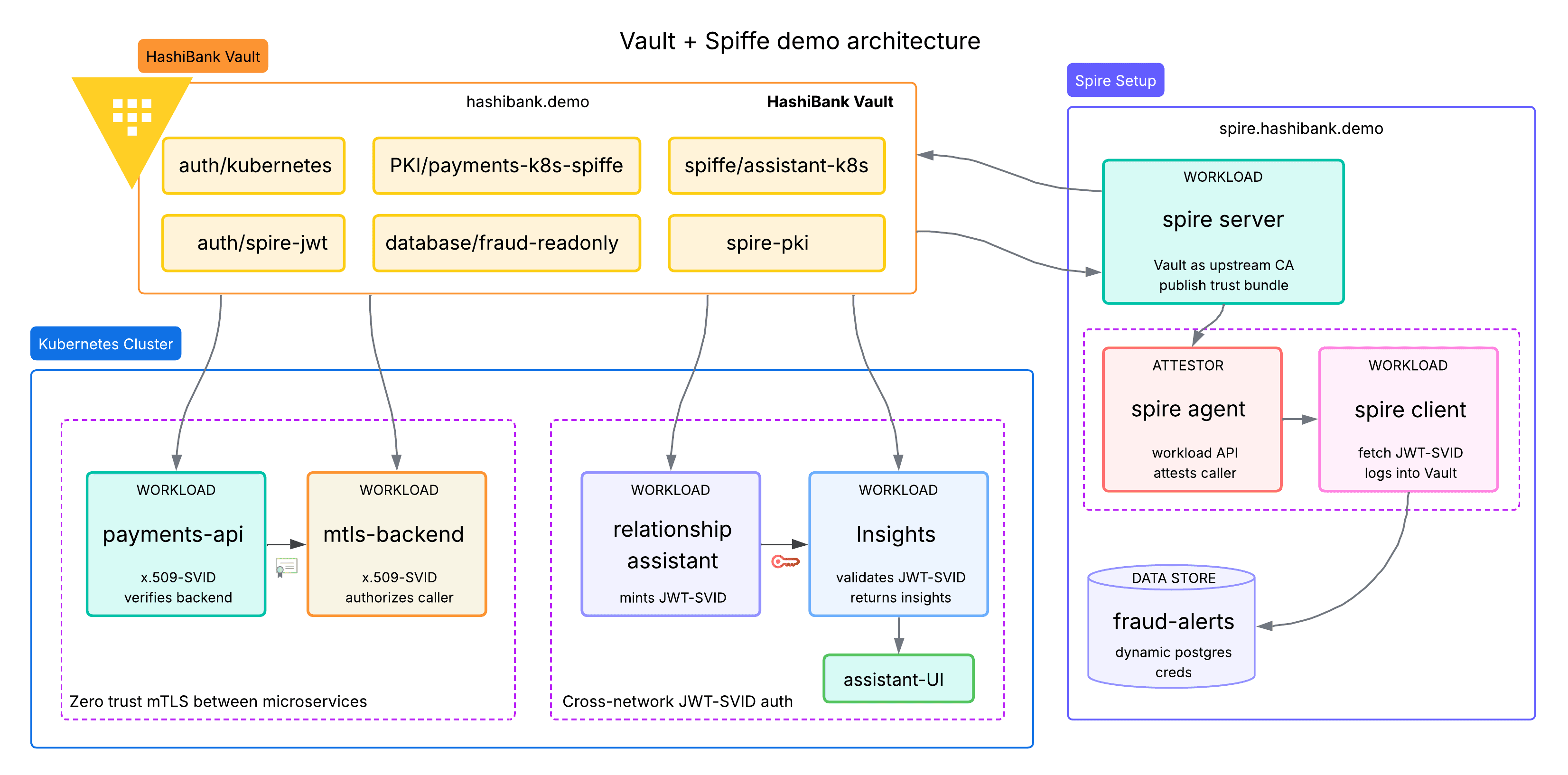
Vault Spiffe demo architecture
»1. Zero-trust mTLS between Kubernetes microservices
In this scenario, payments-api and mtls-backend run in Kubernetes and authenticate to Vault using native service account tokens. Vault uses the extracted metadata, including the namespace and service account name, to issue short-lived X.509 certificates via its PKI engine. These certificates embed distinct SPIFFE URI SANs such as spiffe://hashibank.demo/ns/payments/sa/payments-api.
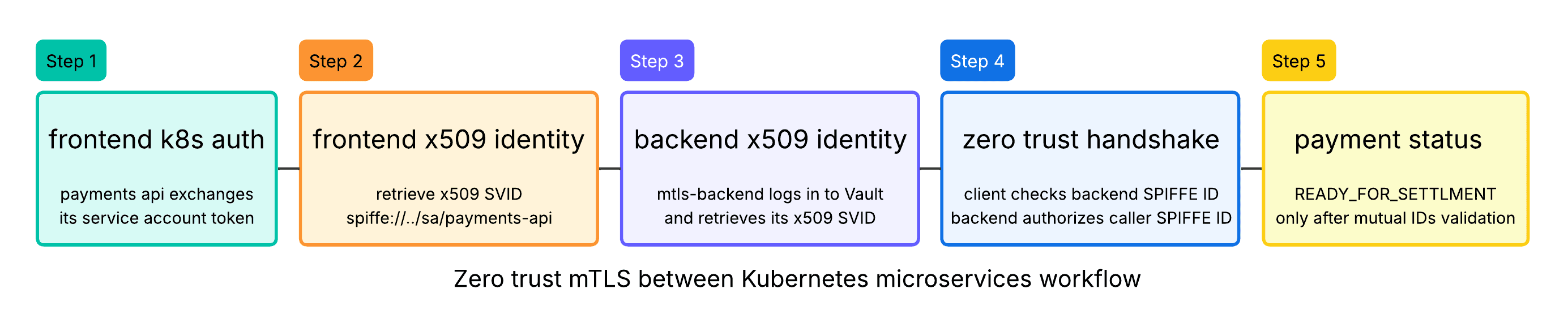
The Kubernetes auth and PKI roles are configured to preserve the workload identity across the entire lifecycle:
# Map Kubernetes service accounts to Vault policies
vault write auth/kubernetes/role/payments-api \
   bound_service_account_names="payments-api" \
   bound_service_account_namespaces="payments" \
   audience="https://kubernetes.default.svc.cluster.local" \
   token_type="batch" \
   token_policies="identity-payments-k8s-issuer"

vault write auth/kubernetes/role/mtls-backend \
   bound_service_account_names="mtls-backend" \
   bound_service_account_namespaces="payments" \
   audience="https://kubernetes.default.svc.cluster.local" \
   token_type="batch" \
   token_policies="identity-mtls-backend-k8s-issuer"

# Configure PKI roles to allow exact SPIFFE URI SANs
vault write pki/roles/payments-k8s-spiffe \
   allow_any_name=true \
   enforce_hostnames=false \
   require_cn=false \
   allowed_uri_sans="spiffe://hashibank.demo/ns/payments/sa/payments-api" \
   max_ttl="8h"

vault write pki/roles/mtls-backend-k8s-spiffe \
   allow_any_name=true \
   enforce_hostnames=false \
   require_cn=false \
   allowed_uri_sans="spiffe://hashibank.demo/ns/payments/sa/mtls-backend" \
   max_ttl="8h"
Once certificates are issued, Vault steps entirely out of the communication path. When payments-api connects to mtls-backend, the microservices execute a standard peer-to-peer mTLS handshake, cryptographically verifying each other's SPIFFE IDs at the application layer before transferring data. This highlights a powerful enterprise architectural pattern: Vault acts strictly as the high-velocity identity issuer, while the data plane independently consumes and enforces those standards-aligned identities.
Why X.509? PKI is chosen here specifically because the destination protocol requires mTLS. This demonstrates an intentional protocol-to-identity fit, rather than a claim that X.509 should always be preferred over JWTs.
»2. Cross-network API authentication using JWT-SVID
In this scenario, the relationship-assistant workload also authenticates via Kubernetes auth, but the downstream target is better served by a signed token than an mTLS certificate. Vault mints a JWT-SVID from the SPIFFE secrets engine, derives the token's sub claim from the Kubernetes identity, and appends business metadata.
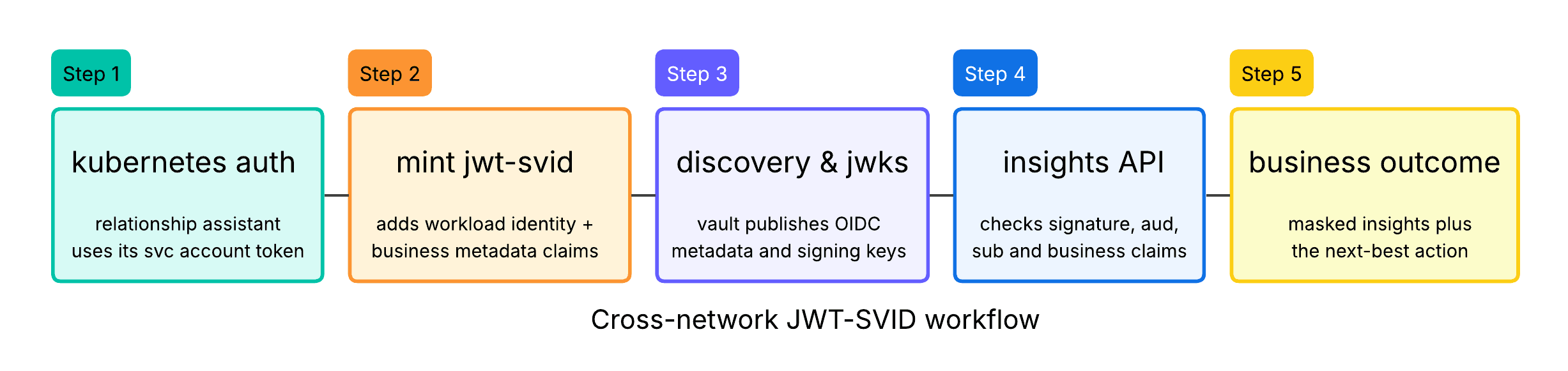
The SPIFFE role template dynamically pulls this metadata from the Vault identity at runtime:
{
   "sub": "spiffe://hashibank.demo/ns/{{identity.entity.aliases..metadata.service_account_namespace}}/sa/{{identity.entity.aliases..metadata.service_account_name}}",
   "bank": "HashiBank",
   "application": "relationship-assistant",
   "line_of_business": "relationship-banking",
   "environment": "demo",
   "customer_data_domain": "masked-assistant-context",
   "kubernetes_service_account": "{{identity.entity.aliases..metadata.service_account_namespace}}/{{identity.entity.aliases..metadata.service_account_name}}"
}
The workload presents this JWT-SVID to a downstream API, implemented in the repo as jwt-consumer. The API reads Vault's public OIDC discovery document, resolves the jwks_uri, fetches the public keys, and validates the signature locally. It evaluates the sub and custom context claims before authorizing the request.
This pattern is essential when crossing service boundaries where direct Vault authentication is not feasible. A portable, cryptographically signed token allows downstream verifiers to safely validate both workload identity and application context without calling back to a central identity provider for every transaction.
A natural architectural extension of this pattern is workload identity federation. This same Vault-minted JWT-SVID can be passed directly to cloud provider endpoints, such as Microsoft Entra ID WIF, AWS STS, or GCP IAM Pools, to exchange it for temporary cloud credentials and eliminate static multi-cloud keys.
»3. SPIRE JWT-SVID authenticated into Vault
In this scenario, workload identity originates from SPIRE rather than Vault. A vault-spire-client workload fetches a JWT-SVID from its local SPIRE agent under the spire.hashibank.demo trust domain. Vault ingests and validates this token via its SPIFFE auth method using the SPIRE federation bundle, then maps the validated identity to short-lived PostgreSQL credentials so the workload can query backend fraud-alert data.
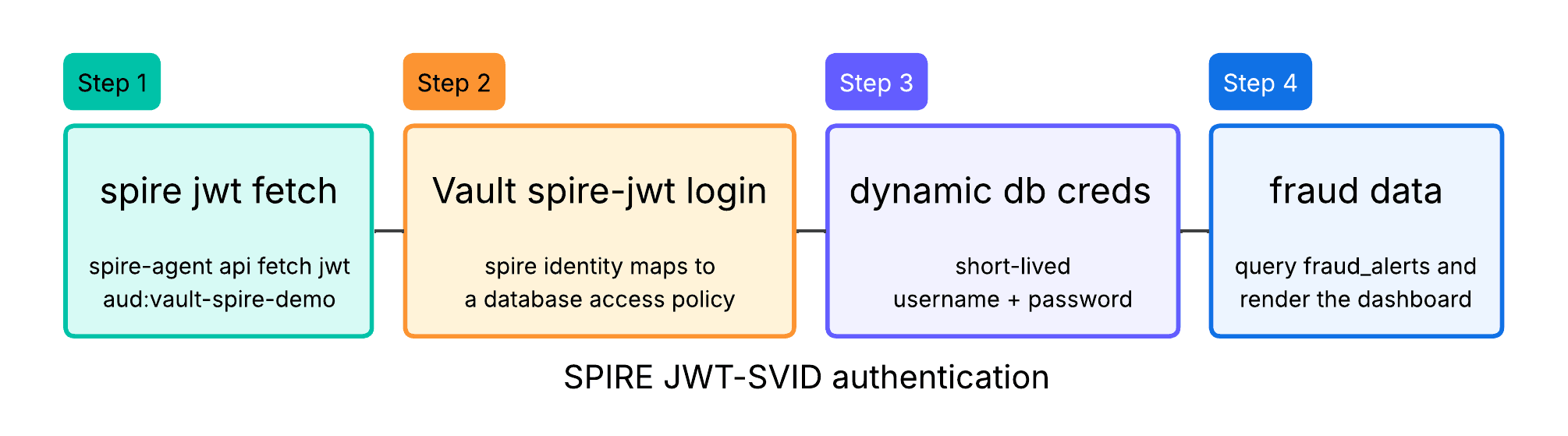
This pattern is valuable for organizations already using SPIRE. It proves that Vault can ingest external SPIRE identities and translate them into dynamic credential brokering without forcing applications to manage multiple, disconnected identity integrations.
Why JWT? Vault directly validates the SPIRE-issued JWT-SVID by using the SPIRE federation bundle, which provides a clean and direct authentication path between the two systems.
»4. Vault as an upstream authority for SPIRE
In this final scenario, an optional SPIRE overlay configures spire-server to use Vault's PKI secrets engine as its upstream X.509 certificate authority. This architecture is validated by verifying that a running workload's SPIRE-issued X.509-SVID successfully chains back to the root CA published at Vault's spire-pki/cert/ca endpoint.
This pattern is ideal for organizations that rely on SPIRE for deep runtime attestation but want to use Vault as their hardened enterprise trust anchor.
Why X.509? This scenario focuses on backend CA delegation and trust-chain verification, so X.509 certificates are the required cryptographic artifact.
»What this means for workload identity strategy
While these patterns address different architecture layers, together they show what a cleaner workload identity strategy can look like.
Modern infrastructure demands two core capabilities:
A portable workload identity format, solved by SPIFFE
A consistent way to authorize that identity, solved by Vault
SPIFFE helps with the first problem. Vault helps with the second. SPIRE remains important when stronger, non-negotiable workload attestation is required.
This clean separation of duties delivers the target state: one standard language to identify workloads, a clear way to issue identities, and a practical control plane to turn those identities into short-lived access.
»Next steps
To operationalize SPIFFE-aligned patterns without waiting for a massive platform overhaul, start with Vault as your workload identity control plane. Vault provides the most direct path to map trusted workload identities to dynamic policies, secrets, and credentials across hybrid environments.
Ready to build? Dive into the documentation and code to get started:
Explore the Vault + SPIFFE demo repository: Clone the runnable Vault Enterprise lab to test all four architectural scenarios and see these zero-trust handshakes in action locally.
Review the Vault SPIFFE secrets engine: Learn how to configure the plugin to dynamically mint and manage compliant JWT-SVIDs.
Review the Vault SPIFFE auth method: Learn how Vault ingests and authenticates external SPIFFE tokens and maps them to enterprise authorization policies.